







Pocket watches work by storing energy in a coiled spring, called the mainspring, and releasing it slowly through a train of gears and an escapement. A typical mechanical movement ticks several times every second, and each tick lets the hands advance by a tiny, precise step. If you have ever wondered how pocket watches work, this guide explains the mechanism, the winding, the space and hypnosis questions, and how to choose a good one.
How pocket watches work
A mechanical pocket watch is a small machine with four main parts: the power source, the gear train, the escapement and the display. Each part passes energy to the next in a steady chain.
The power source is the mainspring, a long, thin strip of metal coiled inside a round barrel. When you turn the crown, you wind the spring tighter. As it slowly uncoils, it turns the barrel and sends energy into the movement.
That energy travels through the gear train, a series of wheels and pinions. The gears reduce the fast, strong turning of the barrel into slower motions, so one wheel turns the second hand, another the minute hand and another the hour hand.
The escapement is the clever part. It works with a balance wheel and a hairspring, which swing back and forth at a steady rate. With each swing, the escapement lets one gear tooth pass, then locks it again. This is the "tick" you hear, and it stops the spring from unwinding all at once.
Finally, the dial and hands show the time. The crown also sets the hands, and on many watches it winds the spring too. For a short historical overview, see this Wikipedia article on the pocket watch.
How does a mechanical watch work without a battery?
A mechanical watch needs no battery because its energy is stored in the mainspring, which you wind by hand. Turning the crown adds tension to the spring, and that tension is the fuel that powers the watch.
Many pocket watches are hand-wound. You turn the crown each day, usually at about the same time, until you feel gentle resistance. Stop there, as forcing the crown can damage the spring.
Automatic watches add a rotor, a weighted piece that swings with the movement of your body and winds the spring for you. These are more common in wristwatches, but some pocket watches use the same idea, and they still wind by hand when needed.
Quartz pocket watches are different. They use a small battery and a vibrating quartz crystal to keep time, with no mainspring at all. They are practical and accurate, but they do not work in the traditional mechanical way.
Do mechanical watches work in space?
Mechanical watches can work in space, but weightlessness makes them less reliable. On Earth, gravity affects the balance wheel, and watchmakers adjust movements to cope with it in different positions. In orbit, that behaviour changes, so accuracy can drift.
The vacuum itself is another concern, since oils and seals are designed for normal conditions. Extreme temperature swings can also affect the metal parts. For these reasons, space missions usually rely on equipment tested specifically for those conditions.
For everyday life, this is only a curiosity. A pocket watch is made for the pocket, the desk or the display case, and it will behave well in normal conditions on Earth.
Does pocket watch hypnosis work?
The swinging pocket watch is mostly a film cliché. Hypnosis does not depend on a watch, and no object can control someone's mind. A watch can simply be a focus point that helps a person relax.
Modern hypnotherapy relies on guided relaxation, attention and a person's willingness to take part. People differ in how responsive they are, and the experience is not a form of mind control.
If you are curious about hypnosis for a practical reason, such as stress or sleep, speak to a qualified professional. A pocket watch is better enjoyed for its mechanism and its craftsmanship.
Five steps to keep a pocket watch running well
Knowing how pocket watches work also helps you care for them. These five habits make a real difference:
- Wind it daily, gently. Stop when you feel resistance, and never force the crown.
- Set the time carefully. Turn the hands forwards, and pull the crown only as the model requires.
- Keep it away from moisture and strong magnets. Both can harm the movement.
- Store it with care. Use a soft pouch or box, and avoid knocks.
- Have it serviced. A watchmaker can clean and oil the movement at sensible intervals.
If the watch stops, runs very fast or sounds odd, ask a watchmaker to examine it rather than opening the case yourself.
Choosing a working pocket watch at Univers Gousset
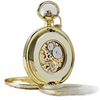
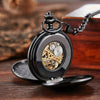
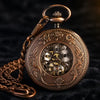
Once you understand the mechanism, choosing a watch becomes more enjoyable. A skeleton case lets you see the gears, spring and balance wheel at work, which makes it a lovely way to watch the principles in this guide come to life. A mechanical skeleton pocket watch in copper is a good example, as the movement is visible through the dial.
Hunter cases protect the glass with a hinged cover, while open face designs show the dial at once. Mechanical models suit those who enjoy daily winding, while quartz models suit people who want simple convenience.
If you would like to compare styles, you can browse the full pocket watches collection and choose the one that suits your taste.
Frequently asked questions
How often should I wind a mechanical pocket watch?
Most hand-wound pocket watches are wound once a day. Choose a regular time, such as the morning, and turn the crown until you feel light resistance. Do not force it. Regular winding keeps the spring tension steady and helps the watch keep better time.
Why does my pocket watch tick so fast?
The ticking comes from the escapement and balance wheel, which beat several times each second. The fast, even sound is normal. It simply shows the movement releasing energy in tiny, controlled steps rather than letting the spring unwind all at once.
Can I overwind a pocket watch?
Yes, if you force the crown after it becomes stiff. Wind slowly and stop at the first firm resistance. If the crown feels unusually tight or loose, or the watch stops, ask a watchmaker to check it before trying again.
Do pocket watches need a battery?
Mechanical pocket watches do not need a battery, because the wound mainspring powers them. Quartz pocket watches do use a small battery. Check the description of any model to see which type it is before you buy.
Conclusion
Pocket watches work by storing energy in a wound mainspring and releasing it through gears and an escapement, which divides time into precise steps. Mechanical models need winding, while quartz models use a battery. To see these ideas in a real watch, explore the Univers Gousset pocket watches collection.