







The pocket watch is most often credited to Peter Henlein, a locksmith from Nuremberg, who was making small portable clock-watches in the early 1500s. Surviving records point to around 1510, though the exact date is still debated. So who invented the pocket watch, and why? This guide covers the inventor, the date, the place, the reasons behind it and the mechanical watch that came before.
Who invented the pocket watch?
The name usually given is Peter Henlein (sometimes written Henlin), a locksmith and clockmaker working in Nuremberg, in what is now Germany. He is described as the maker of some of the earliest small, spring-driven timepieces that could be carried about. This is the answer you will see in most reference works, including Wikipedia's article on the pocket watch.
It is worth being careful, though. Henlein's reputation rests partly on a brief written mention from 1510 and on later accounts. No surviving watch can be tied to him with complete certainty. The famous "Henlein watch" often shown in books is a matter of discussion among historians.
So the honest answer is this: Henlein is the best-documented early maker, but the pocket watch was not the work of one person in a single moment. It grew out of the portable spring-driven clock, a device that several craftsmen in German-speaking lands and elsewhere in Europe were developing at the same time.
Those first pieces were nothing like the slim watches we picture today. They were thick, drum-shaped and often worn on a chain around the neck, not tucked into a pocket. The pocket itself came later, once fashion and watch design had both moved on.
Why were pocket watches invented?
The key breakthrough was the mainspring. Earlier clocks relied on heavy falling weights, which meant they had to stay put. Once a coiled spring could drive the mechanism, a clock could shrink to a size that a person could carry.
Demand followed quickly. Wealthy merchants, nobles and clergy wanted a personal timepiece, partly as a display of status and ingenuity. A small mechanical watch was a luxury object, rather like a piece of jewellery that happened to be clever.
Practical needs grew over the following centuries. Travellers, traders and professionals found a portable watch useful for appointments and schedules. Later, railways and shipping made accurate time vital, and the pocket watch became a working tool for ordinary people, not only a curiosity for the rich.
When and where was the pocket watch invented?
The usual answer to "when was the pocket watch invented" is the early sixteenth century, with 1510 the date most often quoted. The place is Nuremberg, a prosperous city of skilled metalworkers and craftsmen in the Holy Roman Empire.
Nuremberg was a sensible home for this invention. Its guilds produced fine locks, instruments and metalwork, and the same small-scale precision was needed for a portable clock mechanism.
Other regions soon made their own contributions. France, England and Switzerland all became important centres, and each added improvements in design, accuracy and decoration. If you are asking when pocket watches were invented in the form we recognise, the flat, pocketable style developed gradually from the seventeenth century onwards.
Who invented the mechanical watch?
A mechanical watch is one driven by a spring and regulated by a mechanical escapement, with no battery or electronics. In that sense, Henlein's early portable timepieces are generally regarded as the first mechanical watches, so the same name is usually given.
The mechanical watch then improved step by step. The balance spring, associated with the seventeenth century, greatly improved accuracy. Later makers refined escapements, and by the eighteenth and nineteenth centuries the lever escapement had become the standard in quality watches.
Wristwatches came much later and borrowed this same mechanical heritage. A pocket watch is therefore not a side branch of watchmaking but its starting point.
Five steps in pocket watch history
Here is a simple way to follow the story from the first portable timepiece to the watches collectors enjoy today.
- The mainspring: replacing heavy weights with a coiled spring made portable timekeeping possible.
- Early Nuremberg watches: small, ornate, drum-shaped pieces appeared in the early 1500s and were worn as status symbols.
- The balance spring: this improvement in the seventeenth century made watches far more accurate.
- Slimmer designs: cases became flatter and more comfortable to carry in a waistcoat pocket.
- Industrial production: factory methods in later centuries made reliable watches available to far more people.
Owning a piece of pocket watch history
Knowing who invented the pocket watch makes owning one far more enjoyable. At Univers Gousset, we offer pocket watches inspired by this long tradition, from classic open face designs to hunter cases and skeleton dials that show the movement at work.
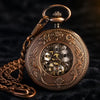
If the mechanism fascinates you, a piece such as this mechanical skeleton pocket watch in copper lets you watch the parts move. Those who prefer a more traditional look may enjoy an open face or hunter style.
You can browse every style in our pocket watch collection. If you are dealing with an antique and need to know its age or value, ask a qualified watchmaker or valuer, as that cannot be judged from a description alone.
Frequently asked questions
Who is credited with inventing the pocket watch?
Peter Henlein of Nuremberg is the name most often given. A record from around 1510 mentions his work on small portable timepieces. Historians note that evidence is limited, and that several craftsmen were developing similar devices at the time.
Were early pocket watches worn in a pocket?
Not at first. The earliest portable watches were bulky and usually hung from a chain around the neck or were attached to clothing. The pocket watch as we know it became more common once designs became slimmer and fashions changed.
Is a pocket watch a mechanical watch?
Many are, and the earliest ones all were. They use a wound mainspring and a mechanical movement. Others, including some modern designs, use quartz movements, which are battery powered and need less regular winding.
Why did people stop using pocket watches?
Wristwatches became more practical and fashionable during the twentieth century, especially for active use. Pocket watches never disappeared, however, and remain popular with collectors and anyone who enjoys traditional style.
Conclusion
Peter Henlein of Nuremberg is the person most often credited as the inventor of the pocket watch, around 1510, although the real story involved several makers and many later improvements. The mainspring made it possible, and centuries of craftsmanship refined it. To find a watch of your own, explore our pocket watches.