







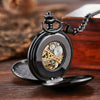




Pocket Watch Mechanical Hunter Men's
In stock | Ready to ship
- The eagle and the phoenix
- Bronze under glass
- Glass window on the back
Order within
D H M Sfor same-day processing.
Unable to load pickup service availability
Free delivery throughout the store, with no minimum purchase. Your order is prepared with care and shipped as soon as possible.
Your payments are encrypted and processed securely on the Univers Gousset store. We accept Visa, Mastercard, PayPal and Apple Pay. No banking data is stored on our servers.
Mechanical bronze hunter pocket watch: the eagle and the phoenix under glass
In the palm of your hand, the bronze hunter case reveals its true nature at once: a living metal, warm to the touch, destined to bear the marks of its wearer across the years. This mechanical bronze pocket watch opens onto a skeleton dial where gilded wheels unfold without restraint, silently marking each second beneath your gaze. The winding crown, faithful to daily ritual, invites you to reconnect with watchmaking in its most intimate form — a mechanism you animate yourself, once each day, as if rewinding the thread of time itself. Upon the cover and openwork caseback, two eagles spread their wings in bronze, figures of the phoenix that traverse the ages without ever fading. A timepiece conceived to endure, and to leave its mark.
The art of distinction
- To wear this timepiece is to introduce into your day an object that slows the eye and invites contemplation — far removed from the indifference of connected watches.
- A collectible piece destined for posterity, it passes from hand to hand as an object charged with history, capable of acquiring over the years a patina and presence that nothing can imitate.
- The daily manual winding creates a discreet yet anchored ritual: a moment of precision and presence to oneself, against the ambient tide of automatism.
- The eagle and phoenix motifs engraved in bronze confer upon this piece an immediately recognizable iconographic singularity, without equivalent in mass-produced watchmaking.
Specifications
| TYPE | Hunter with cover / Skeleton |
|---|---|
| MOVEMENT | Mechanical |
| WINDING | Manual |
| STYLE | Luxury / Classic |
| COLOUR | Bronze |
| DISPLAY | Roman numeral indices, three hands |
| CASEBACK | Openwork with glass window |
How to wear a mechanical pocket watch
The three-piece suit remains the natural setting for this timepiece: slipped into the waistcoat pocket, held by a bronze chain that traverses the buttonhole, it punctuates a masculine silhouette with a touch of another era. In steampunk style, it pairs with a dark velvet jacket, brass buttons, and lace-up boots to compose a coherent and deliberate ensemble. For those who appreciate the interplay of registers, it also accompanies a structured blazer over a white shirt — an unexpected counterpoint that, like our gilded skeleton pocket watch, reminds us that ancient horology willingly dialogues with contemporary elegance.
A gift of character
Certain occasions deserve a present that resembles no other. For a milestone birthday, a retirement, or professional achievement, this bronze phoenix pocket watch says something words struggle to convey: that time given to someone holds value. It suits the watchmaking enthusiast as readily as one who has never owned one — a first step toward a collection, or the centerpiece of an existing display. Those wishing to explore other movements may also consider our automatic iridium pocket watch to complete a collection.
Frequently asked questions
What is a manual-winding mechanical movement and how does it differ from an automatic?
A manual-winding mechanical movement operates thanks to a mainspring that you tension manually via the winding crown, without an oscillating rotor. Unlike an automatic calibre, it does not exploit the wearer's movements to recharge itself. This daily gesture is precisely what constitutes the living link between the piece and its owner.
How do I maintain a bronze case in daily wear?
Bronze naturally develops a patina through contact with air and skin — a normal phenomenon that gives the case its evolving character. A simple wipe with a soft cloth after wearing is sufficient to prevent deposits. Should the patina become pronounced, a light polish with microcrystalline wax restores lustre without harming the metal.
How do I preserve this piece long-term if it is not worn regularly?
A mechanical movement left unworn suffers no damage. For prolonged storage, place the watch in a closed case, sheltered from humidity and significant temperature fluctuations. It is advisable to wind it and allow it to run for a few hours every six to eight weeks in order to keep the lubricating oils in circulation.


The gesture that sets you apart
Opening the case, checking the time, closing it again — a rare gesture, one that never goes unnoticed. At Univers Gousset, we only select pieces worthy of it.

The gift that never goes out of style
A present that won't end up forgotten in a drawer. Every watch leaves in its own case, ready to be given — and built to last long after it's opened.

The mechanism that doesn't cheat
Beneath the case, a real movement — gears built to last, not to look good in a photo. That's the difference between a watch and an accessory.